DashboardLim Build · Sales intelligence
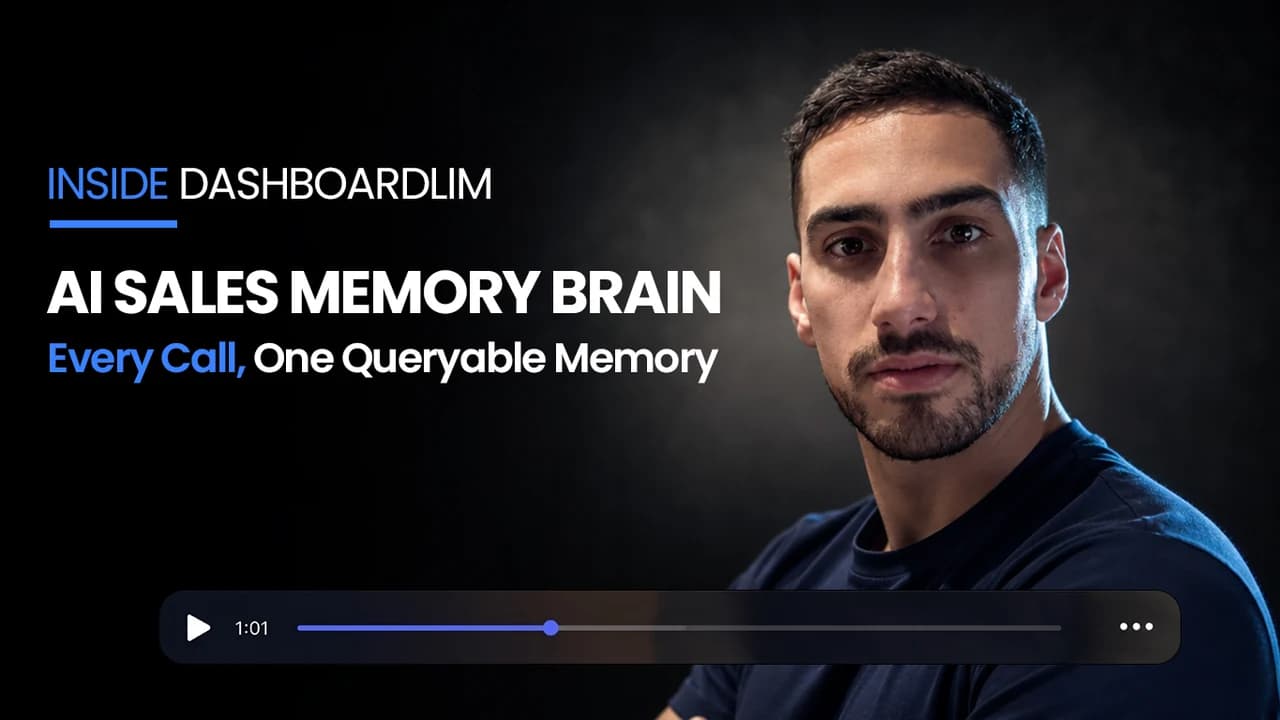
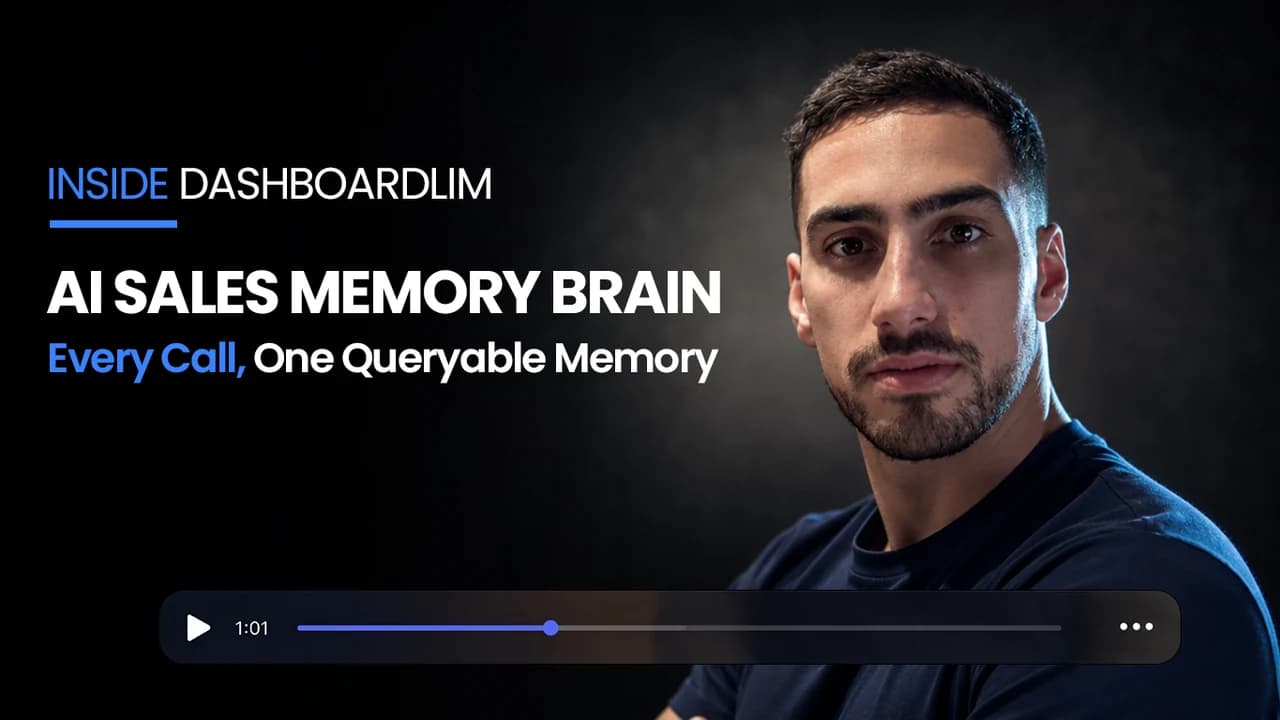
AI Sales Call Memory
Every sales and client conversation is captured, structured and centralised into one searchable company memory the whole team can ask questions of. Built for our own sales operation, held to the same evidence and human-control standards we apply to client systems.
Operator case study
841+ calls remembered
4 recording sources
9 workflows
Human approval kept
Watch how a recorded call becomes searchable company memory the whole team can ask questions of.
- Call capturedRecordings arrive automatically after every call


841+
recorded calls in one memory
551+
structured summaries written
4,027+
searchable memory records
4
recording sources unified
9
workflows feeding the memory
Ask the company memory
Instead of searching recordings, notes and CRM history, the team asks the memory directly and gets the whole relationship back in seconds.
Asked of the company memory
“Tell me about [client]: what are we discussing, what solution are we proposing, the deal context, the latest conversation and the next step?”
What we are discussing. A founder running several consumer brands; every customer conversation handled by hand, remembered nowhere.
The solution we proposed. AI inbox agents that read, prioritise and draft every reply for a person to approve — email and store chat first.
Deal context. Discovery in April, approved two weeks later, phase one live in four weeks — since renewed and widened.
Latest conversation. A check-in refining the agents: gifting keywords, wholesale routing, order-cancellation automation.
Next step. Extend keyword training and enquiry intake; complex and wholesale conversations stay human-led.
Why sales knowledge disappears after calls
Every week, your team has the conversations that decide your pipeline. Setter calls, discovery calls, demos, check-ins with existing clients. Most of what is said in them never makes it past the call itself.
Notes depend on whoever took the call remembering to write them. Recordings scatter across tools, so a deal's history thins out one conversation at a time. The CRM ends up knowing whatever somebody happened to type.
The cost arrives later: proposals that miss what the client actually asked for, handoffs that lose the context, and follow-ups that re-ask questions the client already answered.
From scattered conversations to one searchable memory
tl;dv, HighLevel and Loom calls land in Supabase, and Claude answers from the real company memory. What used to scatter across tools and people now holds in one place.
Notes by memory Details survived only if someone typed them up after the call.
Scattered recordings Every tool was another place a deal's history could hide.
Thin CRM records Deals moved forward on whatever the CRM happened to know.
Repeated questions Without the history, the next call started from a blank page.
How the memory builds itself
Nine workflows, one pipeline, nothing written by hand.
Capture every call
tl;dv, Gemini, GHL and Loom recordings arrive automatically after each conversation.
Store every transcript
Each call lands in one central table with its full text. Nothing lives only in a recording tool.
Classify the conversation
AI types each call (setter, discovery, follow-up, client check-in, onboarding) and routes it down the right path.
Write the structured brief
A clear summary of what was said, decided and promised, ready for a person to review.
Build the memory
What one call becomes
From the end of the conversation to the start of the next one.
Summary written
The full transcript becomes a structured brief covering the conversation, objections, decisions and agreed next steps.
Review doc created
The brief is formatted so the team can scan the call and verify the important details quickly.
Team notified
The summary, deal context and proposed action post to the sales channel for review.
The operating stack
Six layers between the conversation and the answer.
Recording sources
Where calls come from
tl;dvGemini on Google MeetGHL phone callsLoom walkthroughsPipeline
The automation backbone
n8n9 connected workflows
Human approval and data safety
The system drafts. People decide. Every summary waits for a human approval before anything is written to the CRM. Approval is a safety detail built into the pipeline, not an afterthought.
Calls contain prospect conversations, so they stay inside the company. This page shares architecture and aggregate metrics only, never call content.
The system drafts; people decide
Every CRM write requires approval
Transcripts and summaries remain internal
Public copy uses aggregate metrics only
Inside the live memory
Counted against the running system, stated as floors that only grow.
841+ calls centralised
Every one stored with its full transcript in one place.
551+ structured summaries
Written by AI across the stored calls, reviewed by people.
4,027+ searchable memory records
Queryable before the next conversation.
Four recording sources
tl;dv, Gemini, GHL and Loom feeding one memory.
What changed when the team could ask
Every call starts informed The team retrieves the full history before the next conversation instead of re-listening to recordings.
Proposals quote the client Drafts use what was actually said on the calls, not what somebody remembered.
Handoffs carry the whole story Onboarding receives the complete sales history, not a summary of a summary.
Knowledge compounds Each conversation makes the next one sharper; the memory gets more valuable with every call.
What stays manual, deliberately
The boundaries are part of the design.
CRM approval remains human. No summary reaches the CRM on its own.
Follow-up drafts stay review-first and are never auto-sent.
Call scoring is outside the current scope, by choice.
People decide what to ask the memory. It answers, they judge.
Who this system is for
Teams whose best intelligence dies inside recordings.
Founder-led agencies running setter or discovery calls
B2B service teams whose deal history should not depend on memory
Sales teams tired of re-listening to calls before the next one
Operators who want AI speed with human control kept in place
Related resources
Want a memory like this?
Built on your stack. Owned by you. Shipped in weeks.