Case study
Sales Command Center
The dashboard was the last thing we built. First we rebuilt the system underneath it — so the founder and the sales floor could finally run off the same live numbers.
An Australian trade-certification provider
CRM reset & automated hygiene
Raw → trusted data layer
Sales Command Center
Live floor leaderboard
Inside the system
Watch it run, in the founder’s own words
What does running this system end to end actually look like?
1 / 5
The system walked through end to end, then the portal the team opens, the commission showing its working, the wall the floor watches all day, and the lineage behind every figure on it.
Client rollout proof
It didn't stay inside a dashboard link.
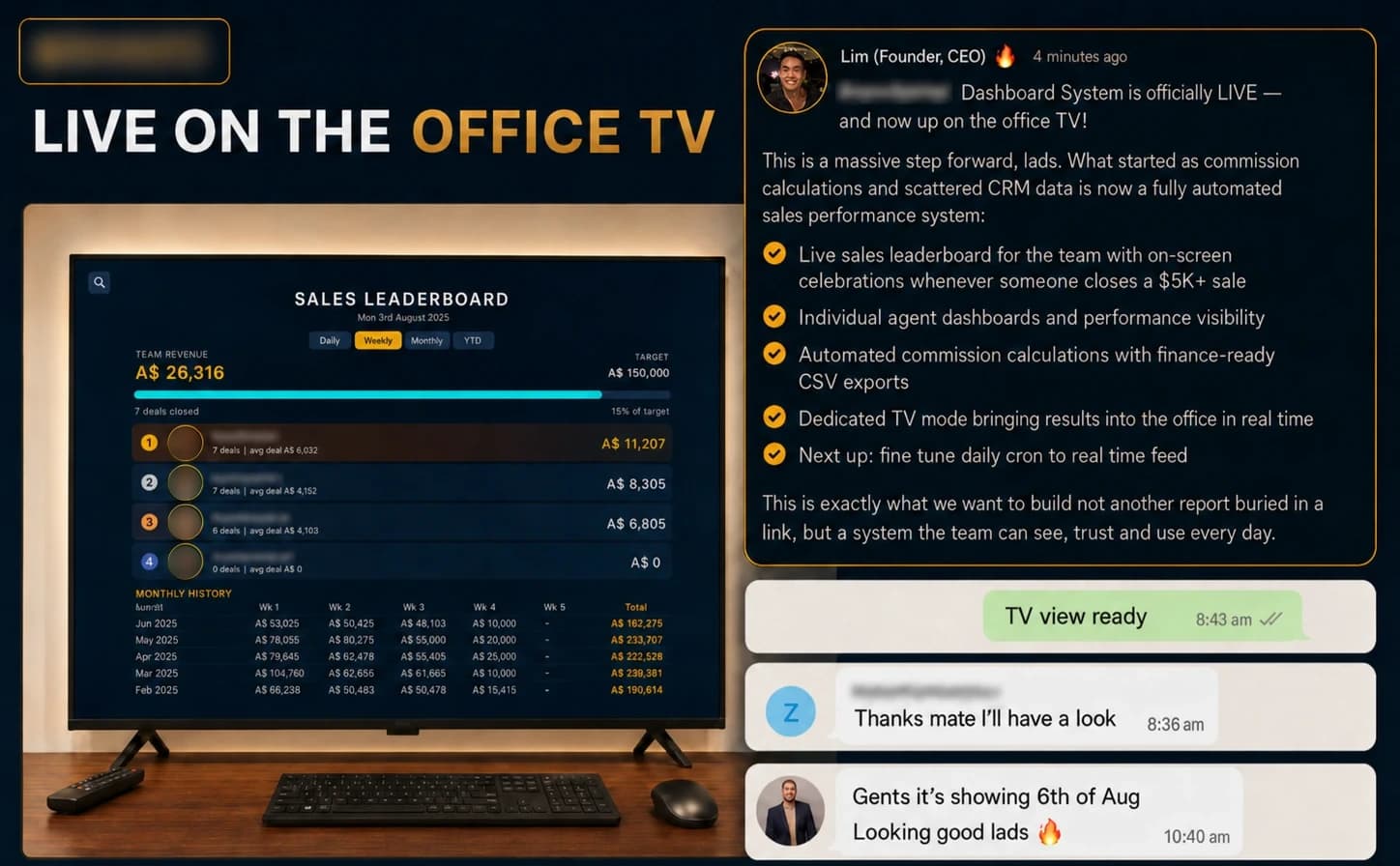
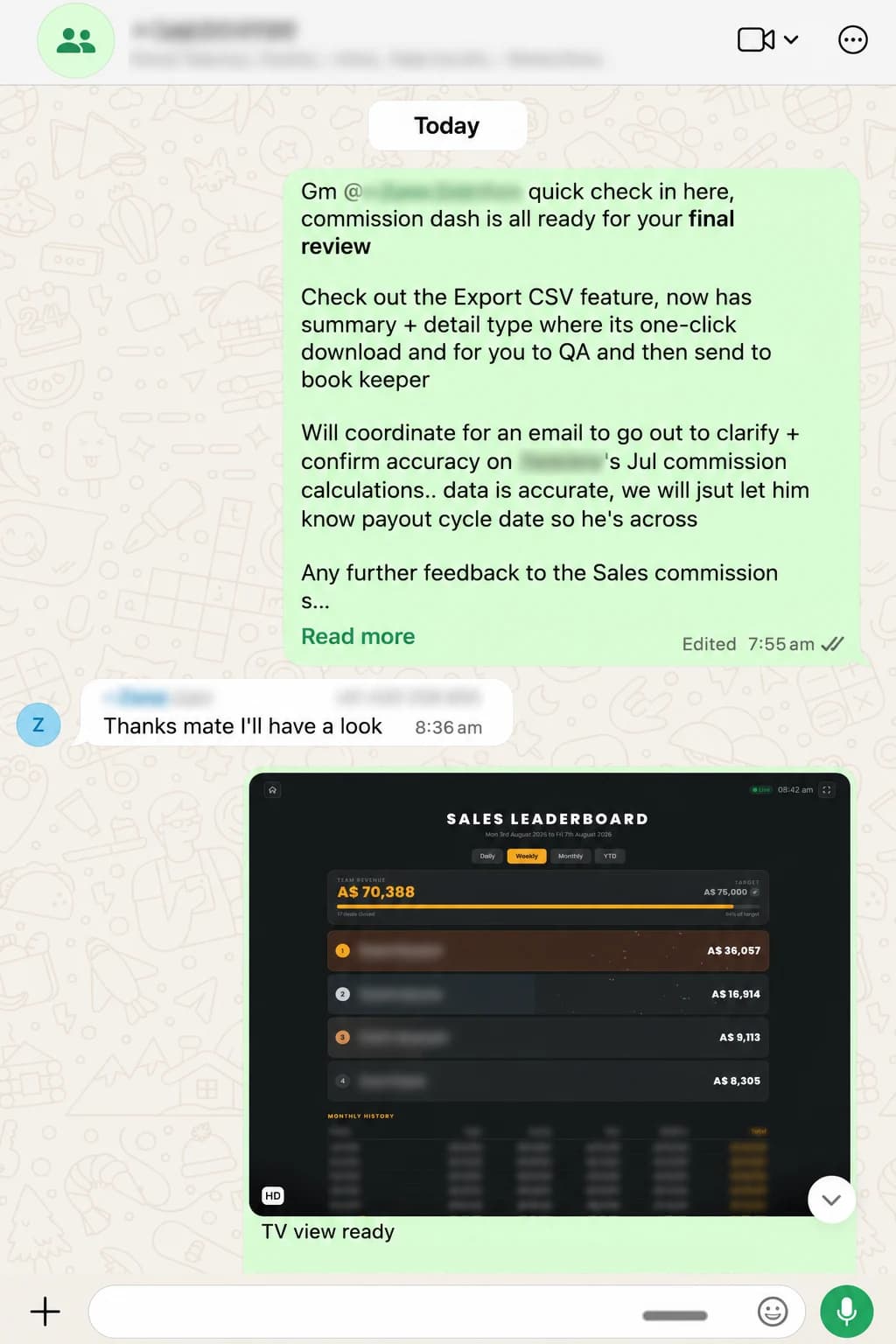
Final commission review before the workflow moved into normal operations.

Watch one sale become everyone's business
Three real screens, in the order they happen.
The money
The front end worked. The back end leaked.
This is a trade school selling nationally recognised certifications at A$5,000 to A$8,000 a place. The ads worked. The setters and closers worked. What sat behind them did not: leads landed in a CRM that was tagged differently by every person who touched it, so the same deal could be counted twice, attributed to the wrong rep, or quietly lost.
Nothing downstream could be trusted, because the source was not trustworthy. Performance sat in one tool, cash in another, and commission in a personal spreadsheet only one person fully understood. Reps had no live view of their own numbers. The scoreboard only existed once the month had already closed.
That is what capped the business. Not lead volume — the foundation under the lead volume. You cannot coach a floor you cannot see, and you cannot scale a number you have to reconcile by hand every payout.
Where the money lands
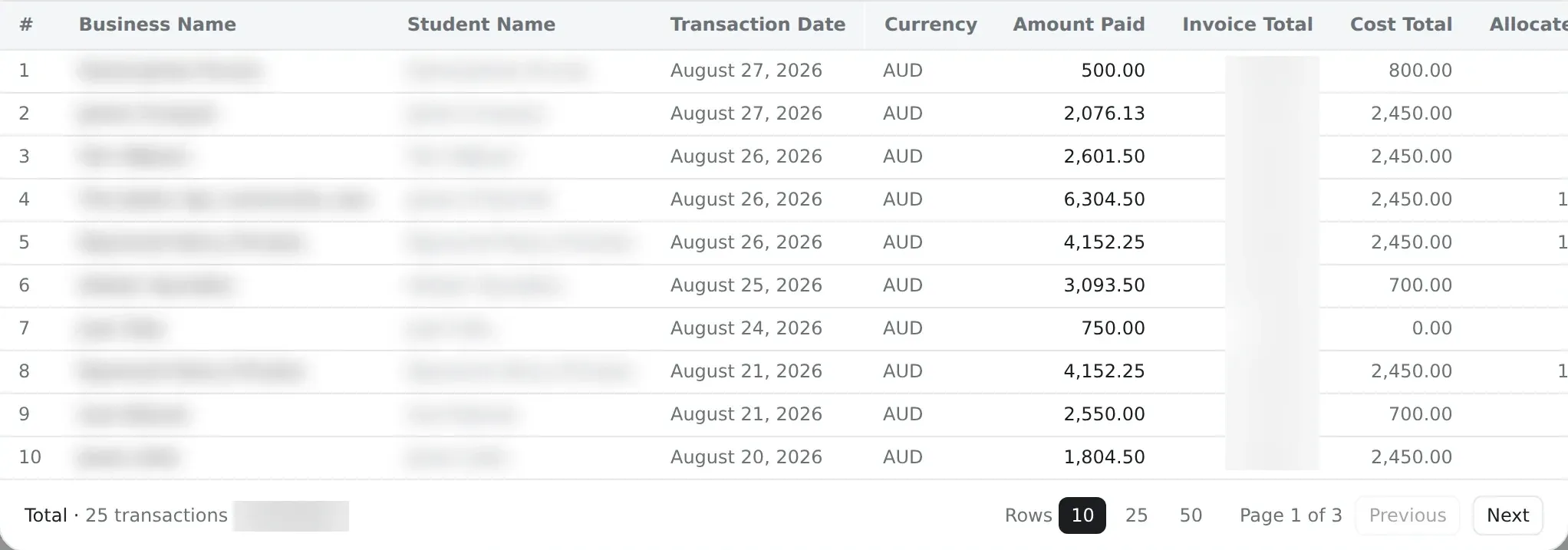
Every number starts as a payment that actually arrived
A sale is not counted because someone marked a deal won. It is counted here, on the payments screen in the CRM, when the money lands — what was charged, through which provider, and whether it went through. The boards, the commission and the payroll export all read forward from this.
A failed charge sits in the same list as the one that worked. Only the successful one reaches a board, which is why a retry never counts the sale twice.
On the wall
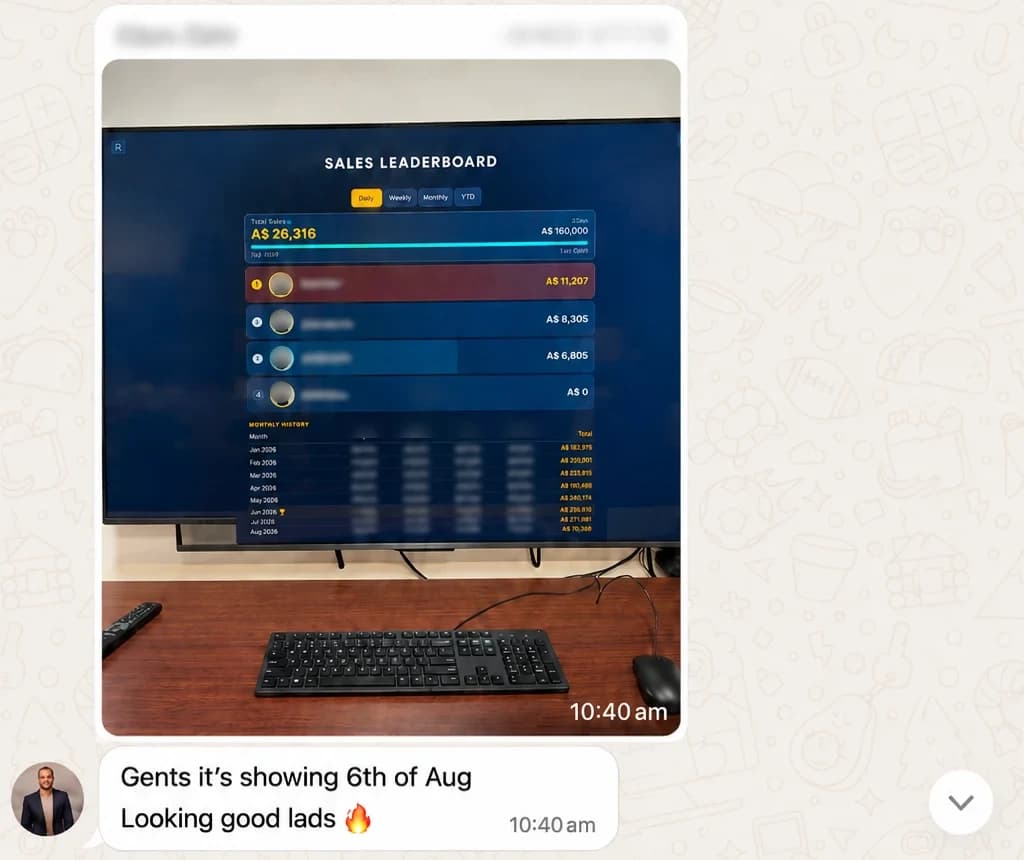
The whole year, running in the room
The same board the floor watches all day, on its year-to-date view — and underneath the leaderboard, every month of the year with each month’s total.
Nine months of trading, on the same screen as today’s standings. Nobody opens a report to see how the year is going.
The same business, running on a different foundation
The ads did not change. Everything underneath them did.
Before
Every rep tagged the CRM their own way
Standings lived in one person's head until the month closed
Every payout started with a reconciliation session
What we fixed first
The dashboard was the last thing we built
A board is only as honest as the records underneath it. Most of this engagement was spent below the surface, in the order the chain actually runs.
- Ads
- CRM reset
- Automated hygiene
- Raw capture
- Trusted layer
- Command Center
Ads bring the leads in
The paid engine was already running and already producing. We changed nothing about it. It is the start of the chain, and it was the one part that was not broken.
How the system works day to day
From a payment landing in the CRM to an approved payslip, in six moving parts.
Payments flow in from the CRM
Every successful payment lands on the boards on the date the money arrives, not when a deal is marked won. Failed charges never double-count.
The team sees the floor
One portal carries the lot: team performance, the funnel, leaderboards and how the cash is actually arriving — every view across the day, week, month and year, with eleven reporting ranges on each.
The wall shows the score
A TV board rotates the standings in the office all day. When someone lands a big sale, the board celebrates it for two days.
Commission calculates itself
Received payments run through the gross-margin formula agreed with finance. Until final cost inputs land, commission is clearly labelled as estimated.
One portal, every view the floor needs
Management, sales and finance open the same system and land on the view their job actually needs.
The dashboards
Sales Team Performance
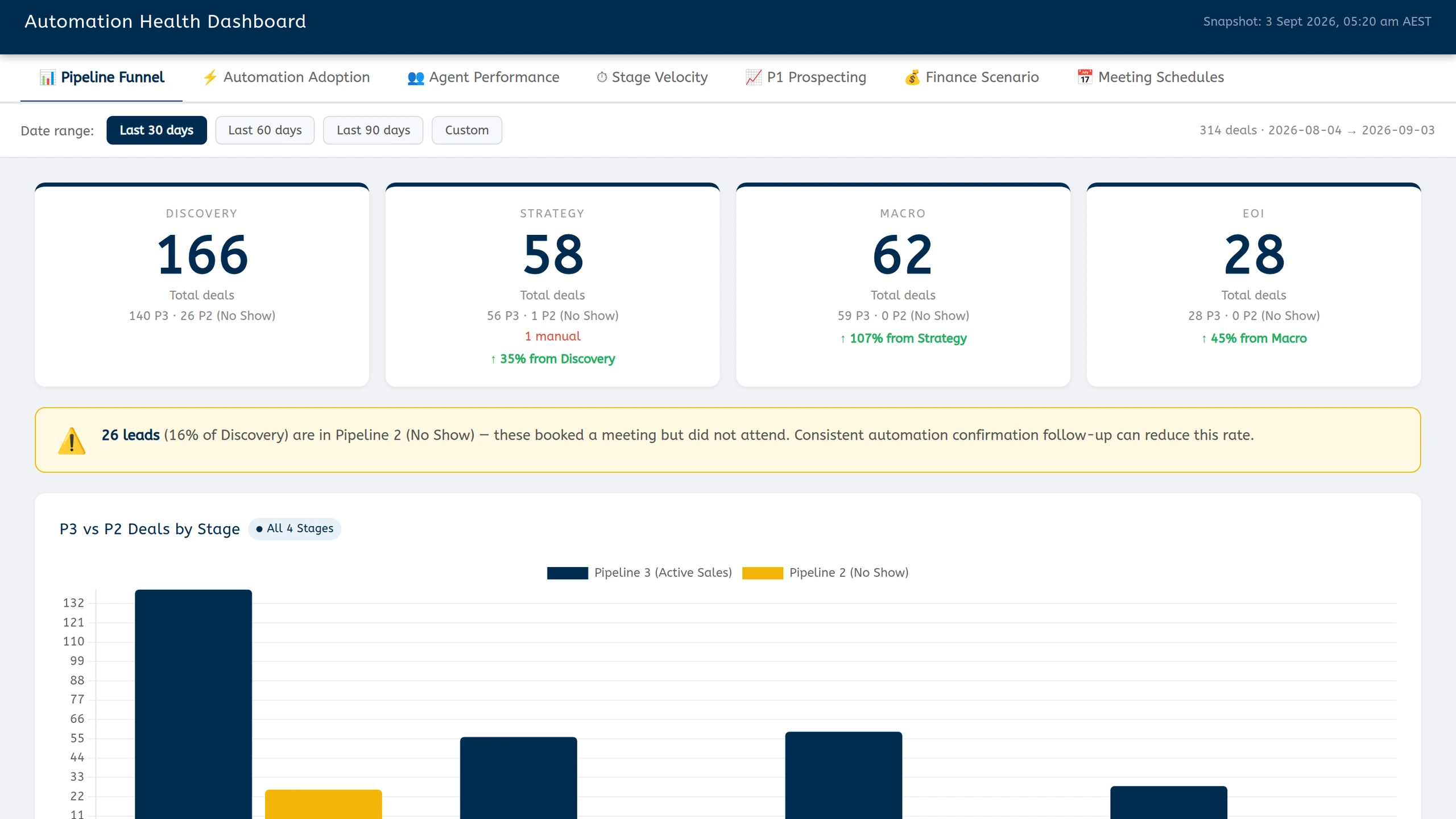
Who is generating revenue, and off how much calling and how many appointments?
1 / 5
Six dashboards behind one sign-in, each with eleven reporting ranges and its own drill-downs.
Every commission figure opens up
Commission is calculated from received payments, and any number on the page can be opened until you are looking at the payment behind it.
The commission surface
What a period exposes
Which figures does finance get for a period, and across how many ranges?
1 / 3
The payroll hand-off
Finance chooses a detailed or summary export, groups it the way payroll wants it, and reviews before anything is paid. The system prepares the numbers; a person still signs them off.
Where every number on the board comes from
The system carries its own map: each source table, each field it reads, and the dashboards and KPIs that field ends up feeding.
A live map, not documentation someone has to remember to update — the feed health beside each table is read from the data itself.
When someone asks about their pay
The hardest question in a sales business becomes a thirty-second lookup.
- A rep asks
"Why is my commission this number?" A fair question when pay rides on it.
- They open their own dashboard
Every figure drills down to the exact deals and payments behind it. No waiting for finance, no arguing with a spreadsheet.
- The system shows its working
Sales count when money arrives, failed charges never double-count, and corrections in the CRM flow through on the next sync.
- The conversation ends differently
Questions about pay end at the payment behind the figure. Finance approves the export, and payroll runs.
In week one, a rep audited his own figure against his own records. The system answered him.
Accountability without a black box
The system shows its working. Every board figure, every commission line and every export traces back to an individual received payment, so nobody has to take a number on faith.
Visibility is deliberate. Each rep sees their own numbers, management sees the floor, and the business controls exactly who appears on each board.
And the system is candid about itself. Each view carries its own feed status, so a dashboard whose data has stopped refreshing says so on its face instead of quietly serving a stale number — and a map inside the portal traces every KPI back to the table and field it came from.
Only successful payments count; failed charges never duplicate a sale
CRM hygiene runs as automation, so corrections hold instead of drifting back
What adoption looked like in week one
No testimonials needed. The behaviour says more.
Every rep got their own dashboard
Individual views went live for the sales team, so each person could see their own performance and commission without asking anyone.
A rep audited his own pay
Within a day of go-live, one rep reconciled his figure against his own records and asked why they differed. The system answered: the gap traced to which payments had actually landed.
Feedback became features the same day
The drill-down gained the columns the team asked for and dropped the ones they did not, because the people paid from these numbers shaped them.
Finance took over the formula
The old manual commission spreadsheet arrived as the reference, and finance is now shaping the final cost inputs that turn estimated commission into exact commission.
What changed
The founder stopped flying blind Revenue, pipeline, ad return and rep performance sit in one place, on eleven ranges. Questions that used to need a request to someone now take a look at a screen.
The floor became visible, and accountability followed Standings stopped living in one person's head. Reps check their own numbers because they can — nobody has to be told where they stand.
Coaching got specific The funnel shows where each rep loses deals — leads, discovery, assessment or close. A manager can work the actual stage instead of telling someone to try harder.
Payout conversations changed Questions about commission now end at the deal and payment behind the figure, not in a spreadsheet dispute. Traceability, not polish, is what turns a dashboard into the system a business pays from.
One system, three views
The same numbers, shown the way each role actually uses them.
Salespeople
Your numbers, always in view
Your own dashboard: performance, commission and every deal behind it
Live standings against the team, across any period
Answers about your pay without waiting for month end
Founder & management
The whole business at a glance
Honest boundaries
What the system runs on its own, what your people keep, and what is still being finished.
Runs on its own
CRM hygiene — tagging, stage moves and attribution run as workflows
Raw capture and the transformed layer built on top of it
Boards update as payments land
Commission calculates from the agreed formula
People decide
Payroll review and approval every period
Edge-case attribution automation should not rule on
What stays with people on purpose
Record-keeping is automated. Judgement is not. These are the calls we deliberately left with your team.
Payroll approval. The system exports; a person reviews and signs off before anyone is paid.
Commission cost inputs, which finance owns and controls.
Edge-case attribution — a split deal, a reassigned account — where the right answer is a decision, not a rule.
Who appears on each board, and what the floor is aiming at.
Who this system is for
This build fits teams who recognise their month end here.
Founders whose ads work but whose backend cannot keep up with them.
Businesses where every rep tags the CRM a slightly different way.
Sales leaders building accountability on live numbers, not verbal standings.
Finance teams paying commission who are done reconciling by hand.
Businesses paying for BI tools that never fit how they actually sell.
Related resources