Founder Brief
Three systems to install before Q4 planning
Founder Brief
DashboardLim · Founder's desk
2026-07-016 min readThis is not a framework post. These are three systems DashboardLim built and operates. A weekly reporting cadence running for one client since early 2025. An inbox system that sorts and drafts for a family chocolate factory. The sales-call memory our own team queries before every call. What follows is what happened when they ran, told through the artifacts they produced.
71
dated weekly reports in one client's folder
81
noise messages dropped in a single day
841+
calls in one searchable memory
Every screenshot in this issue is a real capture from live systems. Staff names, customer details and contact details are masked, and some shots are cropped for readability. No values or messages were rewritten.
System 01 · Weekly reporting
The report that arrives before anyone asks
Every week at one Australian financial-services client closes with the same status report. It has run that way since early 2025. There were 71 dated reports in the shared folder the day we took these screenshots.
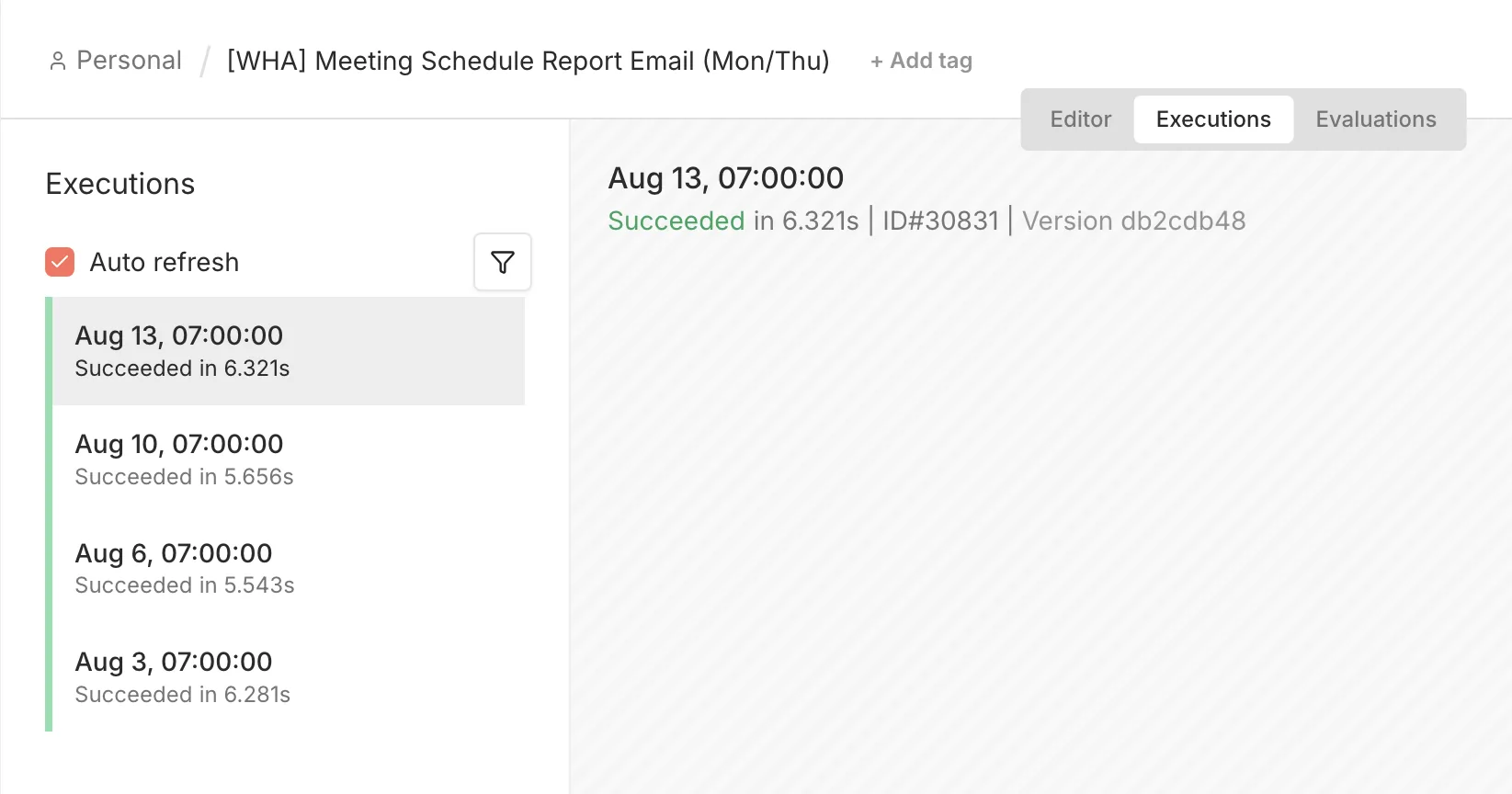
The week opens the same way. A scheduled email carrying the week's meetings lands before anyone has asked. The assembly is automated. The words about what the week meant are not, and that split is deliberate.
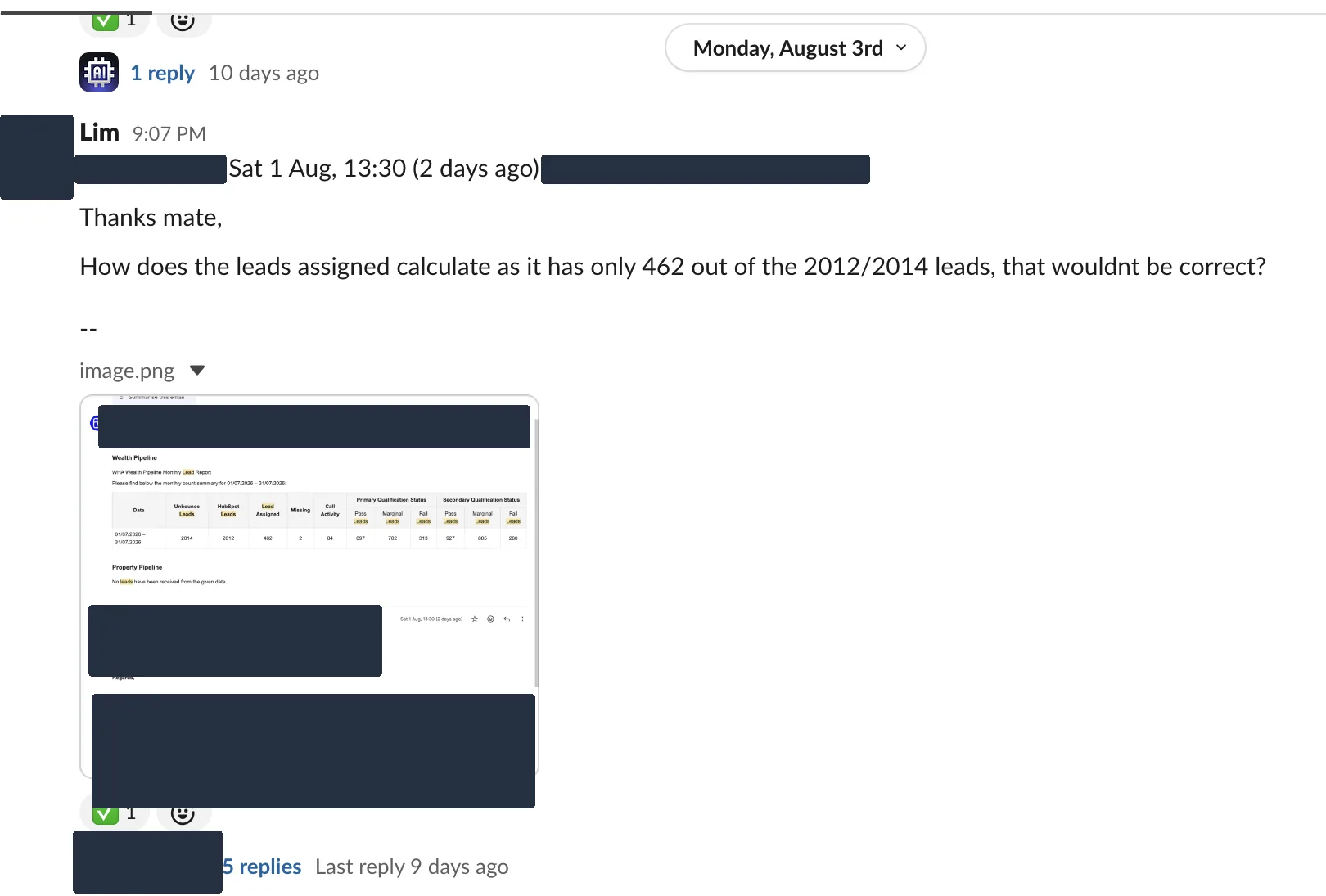
The Saturday before one August week, the founder replied to the monthly lead report. The leads-assigned figure said 462 out of roughly two thousand leads. That looked wrong to him.
His question, the screenshot above, was posted into the shared Slack channel on the Monday. Five replies later the calculation was explained and the tick went on. That is what a scheduled report is for. The challenge lands on a number everyone can see. It never becomes a meeting about what the numbers even are.
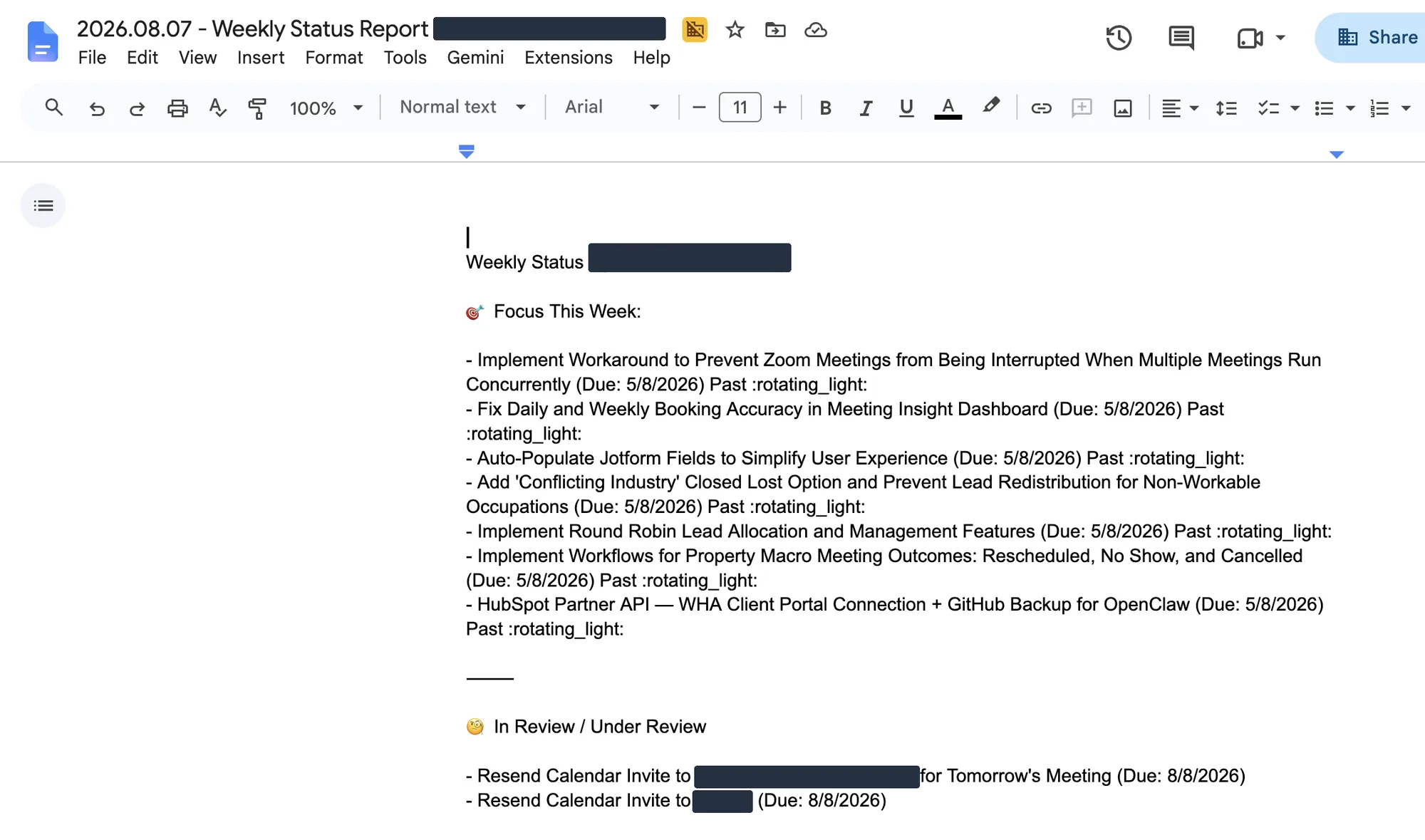
Requests travel the same road. A change asked for in chat becomes a tracked ticket the same evening. The work then shows up in the Friday report. The fourth item under Focus This Week below was raised in that channel eighteen days earlier. Raised in chat, tracked on the board, reported on Friday. The loop closes in writing.
What to look at
- Overdue work carries a "Past" flag. Slipping items are reported, not quietly dropped.
- The fourth Focus item started life as a chat message eighteen days earlier. The report is where requests come back as done work.
- The scheduled emails are assembled by a small workflow on the client's own stack. The run log above is its actual history.
A report does not earn trust by being right every week. It earns trust the first time someone pushes on a number and gets a straight answer in the open.
System 02 · The founder inbox
The inbox that does the looking
Freckleberry is a family chocolate factory. Seven mailboxes plus WhatsApp, Meta DMs and Shopify Inbox. Around 50 customer emails a day in peak season. A team member cleared the backlog between 8pm and 1am.
We built one triage layer across all of it, and the first thing it does is not AI. Plain rules, editable by the client from a dashboard, drop newsletters and notifications before the model sees anything. On 16 June that filter removed 81 messages in a single day. Every drop is logged with its reason.
Then the mistakes, because there were some. An early version read only the newest message in a thread. It politely re-asked questions the customer had already answered. In one case it drafted a gift-card reply keyed off a stray phrase, missing what the thread was actually about. The fix was a sharper rule, not a smarter model. Read the whole thread.
It also guessed at prices on quotes. Once it quoted a school discount inline that should have gone through the approval flow. So pricing was removed from every AI reply. Drafts now link to the website instead of quoting numbers.
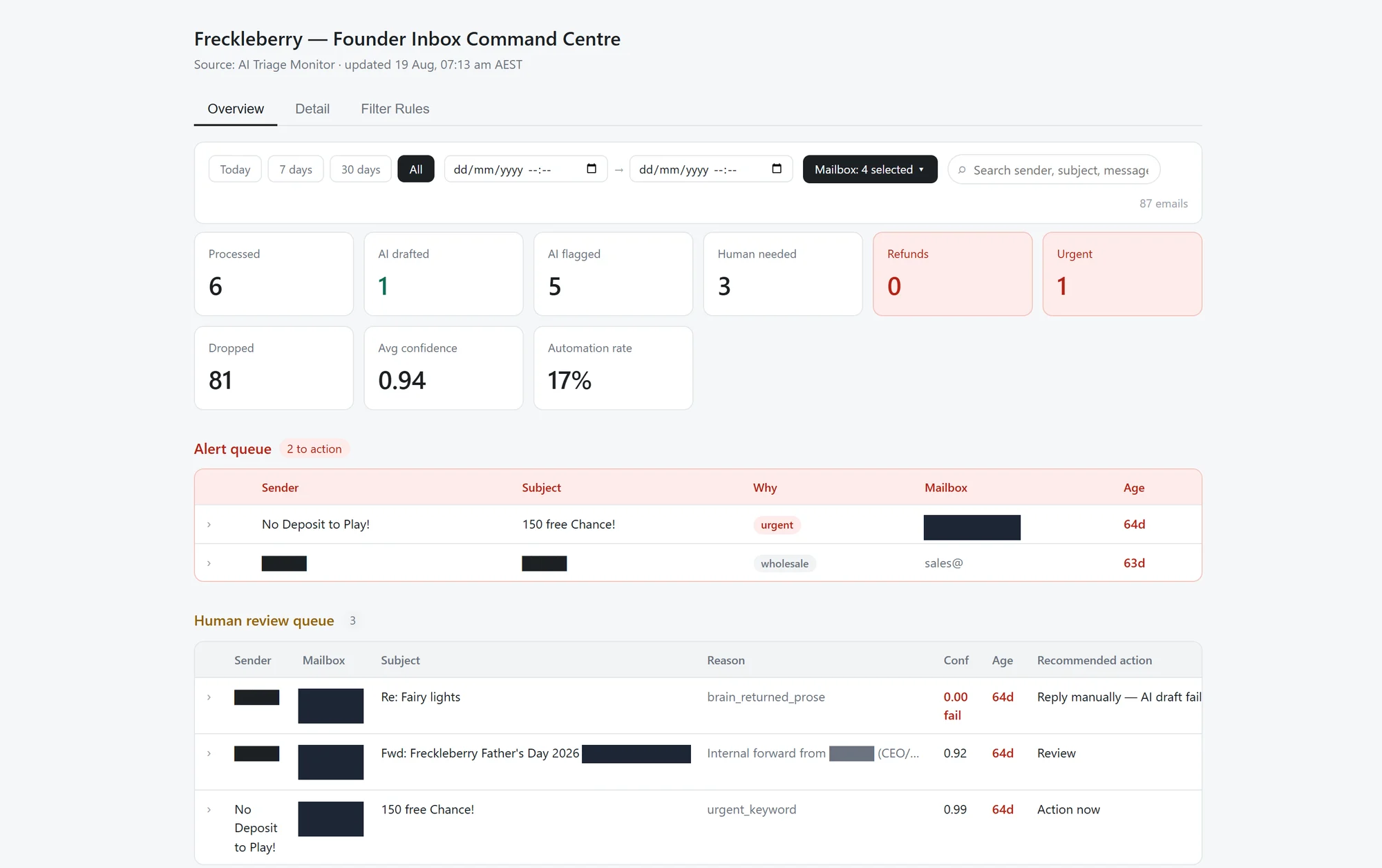
What survived is a system that prepares the work and keeps people in charge. Every reply waits in the mailbox's own Drafts folder with an [AI DRAFT] prefix. Refunds over an agreed threshold, legal or regulator mentions and diet-critical questions never become drafts at all. They ping a named human. The founder works two queues and a 7am digest instead of a midnight inbox.
What to look at
- brain_returned_prose, confidence 0.00. When the model answers in the wrong shape, the draft fails openly and the row reads "Reply manually". Failures land in front of a person.
- Nothing on this screen can send itself. The system drafts, routes and escalates. People send.
The draft is the product. Auto-send is something a category of reply has to earn. Weeks of unedited drafts, sign-off, a kill switch. As of this writing, no category has. Money, legal and safety never graduate at all.
System 03 · Company memory
The handoff that keeps the conversation
The third system is ours. Every sales and client call at DashboardLim lands in one table with its full transcript. The recordings arrive from tl;dv, Gemini, GHL and Loom. AI types the call and writes the structured brief.
The brief waits for a person's approval in Slack. Only then do the CRM note, the follow-up draft and the next step land. Nine workflows run the pipeline.
Counted against the live database this month, the memory held 841 calls, 551 structured summaries and 4,027 searchable records. Those numbers are floors. They only grow.
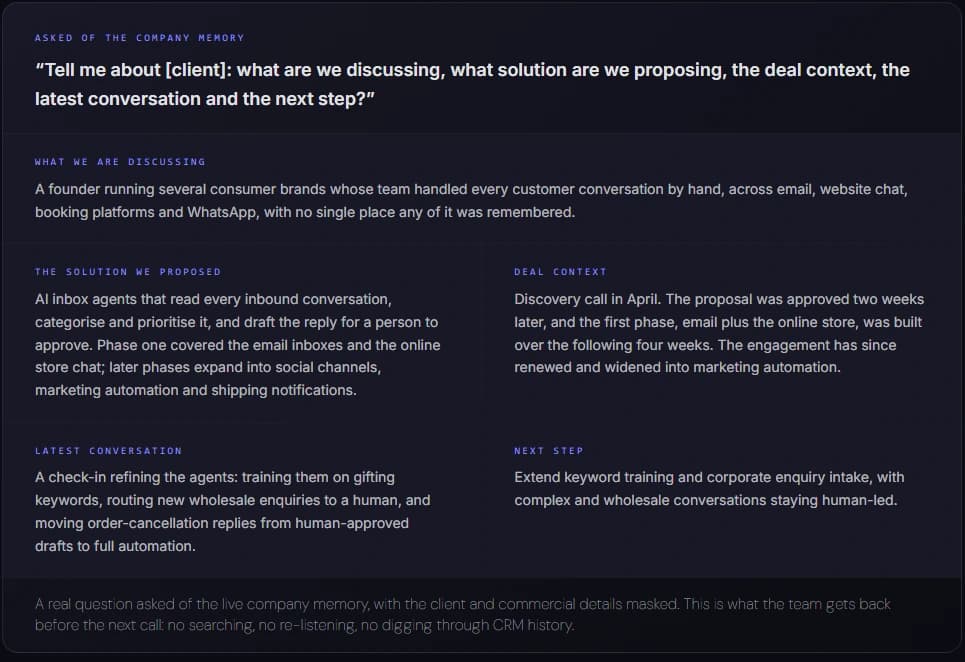
What that buys is easiest to show with the client from System 02. The discovery call happened in April. The proposal quoted that call back to the founder and was approved two weeks later. Every check-in since has started from the last conversation instead of a re-introduction. The most recent one's decisions, training the agents on gifting keywords and routing wholesale enquiries to a human, are recorded as next steps. Below is a real question asked of the live memory. The client and commercial details are masked.
What to look at
- Approval is a gate, not a courtesy. No summary reaches the CRM on its own.
- This answer is why handoffs stop leaking. The next person starts from the conversation, not from someone's memory of it.
Notes used to depend on whoever took the call remembering to write them. Now the call writes the first draft of its own record, and a person signs it off.
What the three share
Same shape, three times
Look across the three and the shape repeats. Machines do the collecting, routing and drafting on a schedule. People own the judgement. The explanation in the thread. The edit to the draft. The approval before the CRM write.
And every exception has an address. A challenged number becomes a thread. A strange message becomes a queue row. A summary becomes an approval with a name on it.
None of these systems is exotic, and none is finished. The reporting cadence gets challenged. The inbox gets corrected. The memory gets queried and edited. That is the point. The systems that survive are the ones built to be questioned.
Steal the shape
None of this needs new tools. It needs a few decisions made in the right order.
Put the week on a schedule
One report, a fixed day, a fixed shape. Send it before it is polished. A thin report that arrives every week beats a perfect one that doesn't.
Filter with boring rules first
Drop the noise deterministically and log every drop with its reason. Save the model for the messages that deserve one.
Draft, don't send
Let AI prepare the reply, the summary and the CRM note. Keep a person on every send. Give auto-send a graduation path it has to earn. Keep money, legal and safety out of its reach entirely.
Give every exception an address
A challenged number, a strange message, a refund over threshold. Each should land in a thread or a queue with an owner, and resurface when it is resolved.
Keep the conversation
Record the calls, transcribe them, make the history queryable. The next conversation should start where the last one ended.
The proof behind this issue
System 02 in full. The architecture, the message flow and the honest outcomes of the Freckleberry inbox build, on the proof feed.
Case study
· Inbox automation
Founder Inbox OS
Seven inboxes and customer channels were feeding one overloaded team. We built a human-reviewed system that sorts every message, drafts the next reply and escalates anything that needs judgement.
7
mailboxes triaged
81
noise messages filtered in one morning
0
replies sent without human approval
Freckleberry
2026-06-18OpenClawn8nRailwayRead the case study →Get the next issue in your inbox
Real systems we've shipped, with practical lessons you can use today.
Which of the three is your gap?
The report nobody reads. The inbox that runs the day. The deal history that lives in someone's head. Tell us which one is costing you, and we will show you what the fix looked like for the founders above.
Keep reading
Growth Playbook
· Newsletter
The weekly reporting cadence that ends "how are we doing?"
A teardown of a reporting system that has run for a real client for a year and a half. The actual Monday emails, the actual Friday reports, the Slack thread where a number got challenged, and the workflow underneath.
DashboardLim
2026-06-177 min readRead the issue →Case Study Breakdown
· Newsletter
Teardown: the inbox that drafts itself
What building the Founder Inbox OS for Freckleberry actually taught us — why the noise filter is plain rules, why triage runs on one golden rule, and why the draft, not the send, is the product.
DashboardLim
2026-06-247 min readRead the issue →Sales automation
· Sales
AI Sales Call Memory
Every sales and client conversation becomes searchable company memory. Instead of hunting through recordings, notes and CRM history, the team asks the memory and walks into the next call knowing everything.
DashboardLim
2026-06-05Read the case study →